Blogs
SS 202 Stainless Steel Pipes for Construction: Where They Work and Where They Dont
India consumed 4.80 million tonnes of stainless steel in FY 2024–25, an 84% jump in five years, and construction was one of the biggest drivers. Much of that growth is riding on 200-series grades like SS 202. The reason is simple: SS 202 stainless steel pipe costs roughly 25% less than 304. But that saving is only real if the pipe is used in the right place. Put it in the wrong place, and the cost of rework, staining and replacement will wipe out every rupee you saved.
This is not a sales pitch for 202. It is a practical boundary line. Here is exactly where 202 stainless steel pipes belong on a construction site — and where it will fail you.
What Is SS 202 Stainless Steel Pipe?
SS 202 is an austenitic stainless steel that uses manganese and nitrogen to partially replace nickel. A standard 202 grade stainless steel chemistry looks like this: chromium 17–19%, nickel 4–6%, manganese 7.5–10%, carbon 0.15% max, and nitrogen up to 0.25%. Tensile strength is 515 MPa minimum, and yield strength is 275 MPa minimum. That makes it stronger than many people expect from a “cheap” grade.
The trade-off is nickel. SS 202 grade carries only 4–6% nickel, while 304 carries 8–10.5%. Nickel is the element that drives both corrosion resistance and price. Less nickel means ss 202 pipe is more affordable, but also more limited in aggressive environments.
SS pipe full form is simply “stainless steel pipe.” The “SS” does not indicate a specific grade. You must always confirm whether the pipe is 202, 304 or something else before it reaches your site.
Need the full technical specification for SS 202 pipes?Explore the Venus Engineers SS 202 pipe page for chemistry, sizes and finishes.
Why Construction Buyers Choose 202
Three reasons dominate every ss 202 price conversation.
First, cost. SS 202 is less than 304 in the Indian market. On a project that needs tonnes of ss round pipe for railings, furniture frames or light structural work, that gap is significant.
Second, strength. The yield strength of stainless steel 202 grade is comparable to 304. For ornamental and light structural applications, it does the mechanical job without complaint.
Third, availability. Stainless steel pipe manufacturers in India stock 202 in a wide range of stainless steel tube sizes, from 6 mm OD to 114 mm OD and beyond. SS square pipe price and stainless steel round pipe rates are easy to compare because the supply chain is mature.
But strength and price are not the whole story. 202 stainless steel has a corrosion ceiling. Cross it, and the pipe will tell you — usually within one or two monsoons.
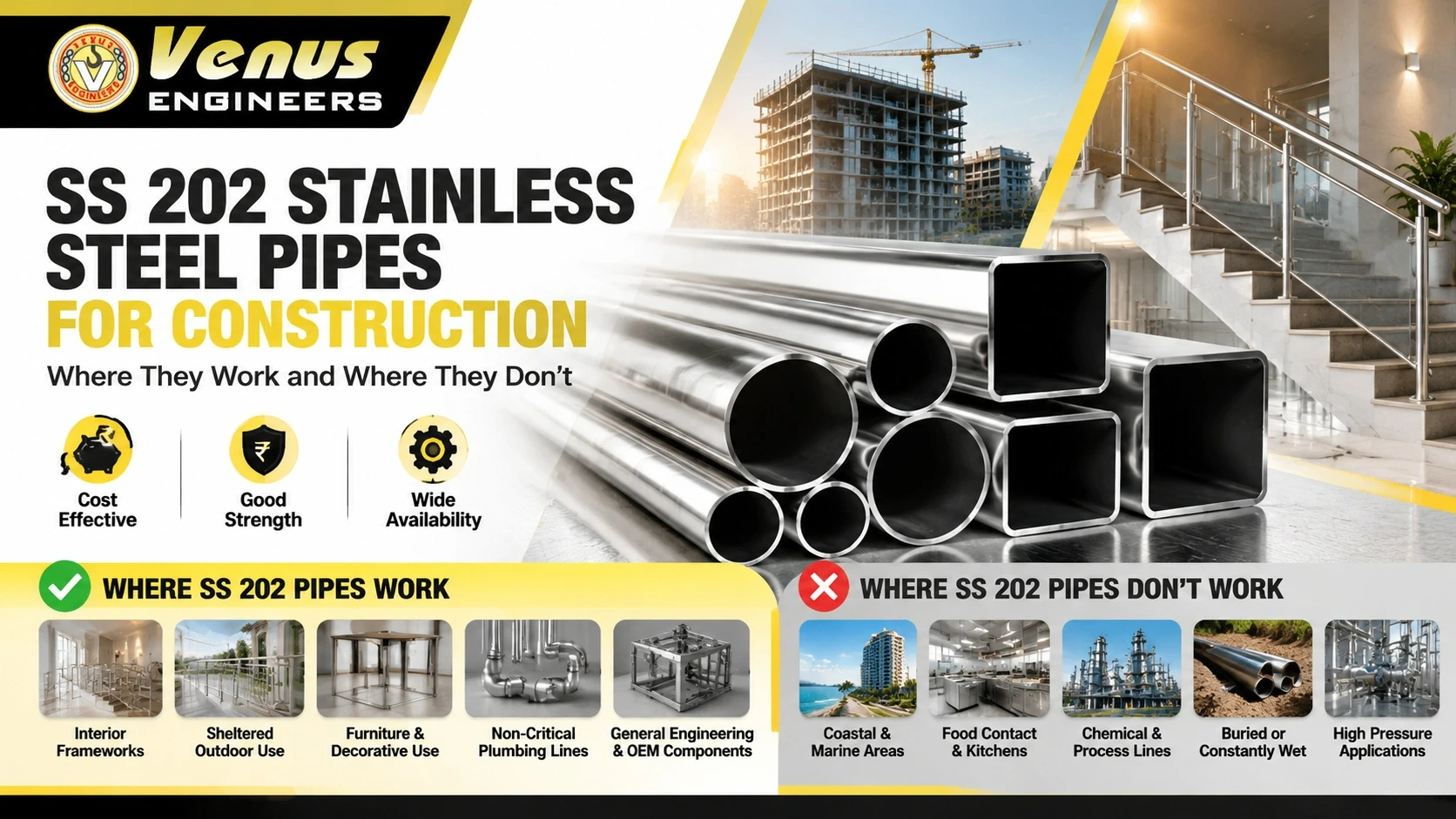
Where SS 202 Pipes Work
SS 202 pipes and tubes perform well when the environment is dry, sheltered and non-chemical. These are the safe zones:
Interior architectural frameworks. Partition frames, false-ceiling supports, display fixtures, indoor handrails and furniture frames. The pipe stays dry, and the surface finish — matt, bright or No. 4 — holds up well.
Sheltered outdoor fabrication. Balcony railings under a roof, covered walkways, staircases in enclosed shafts, and window frames that are protected from direct rain and salt spray. SS round pipe in 202 is a reasonable choice here, provided the finish is maintained.
Light structural and decorative use. Furniture legs, shop-fit frameworks, exhibition structures, trolley frames and general fabrication where the pipe is not carrying heavy structural loads or sitting in water.
Non-critical plumbing lines. For temporary or non-potable water lines in dry indoor conditions, ss 202 grade can work as an economical option. But this is a narrow use case. It is not a substitute for 304 in potable plumbing.
General engineering and OEM components. Brackets, guards, machine frames and enclosures in dry factory environments. Here, stainless steel pipes and tubes in 202 offer a good strength-to-cost ratio.
For a broader look at how stainless pipes are selected across industries, It explains the application logic that separates decorative, structural and process use.
Where SS 202 Pipes Don’t Work
This is the section most suppliers avoid. Read it carefully.
Coastal and marine environments. SS 202 is not a marine grade. Chloride from sea air and salt spray attacks the passive layer, and pitting corrosion follows. A study on MIG-welded AISI 202 confirms that its corrosion resistance is “somewhat less” than 304 in chloride environments. For coastal railings, gates, balcony grills or façade elements, use 304 or 316. The saving on 202 is not worth a rust-stained building handover.
Food-contact and kitchen surfaces. 202 stainless steel is not the default food-grade material in most markets. It should not be used for direct food contact, commercial kitchen tables, utensils, sinks or food-processing lines. 304 is the standard choice for food safety. If a supplier tells you 202 is “food-safe” without qualification, ask for the test certificate and the specific food-contact approval. In most cases, it will not exist.
Chemical and pharmaceutical process piping. SS 202 is not designed for aggressive chemicals, acids or pharmaceutical process lines. Even in citric acid, where 202 shows comparable resistance to 304 at ambient and 50°C, it falls behind at 70°C. In a process plant, temperature spikes and concentration changes are routine. Do not specify 202 for critical process piping.
Buried, submerged and constantly wet service. Underground piping, sump lines, swimming-pool structures, fountain frames and drainage channels keep the pipe wet for long periods. SS 202 has a lower nickel reserve to repair its passive layer, and prolonged wetness accelerates corrosion. Use 304 or a non-metallic alternative.
High-chloride industrial atmospheres. Chlorine plants, bleach handling areas, swimming-pool chemical stores and certain dyeing units expose the pipe to chloride levels that 202 cannot handle. Pitting and crevice corrosion are likely.
Heavy structural or pressure-bearing applications. SS 202 is strong, but it is not a pressure-piping grade. Do not use it for steam lines, compressed-air lines, high-pressure water lines or structural members whose failure would endanger people. ASTM A554 covers welded mechanical tubing for ornamental, structural and exhaust applications — not pressure service.
If your project falls into any of these categories, Venus Engineers will tell you honestly and quote 304 instead. That is how you protect your project.Review the SS 304 pipe range here before you finalise the grade.
SS 202 vs SS 304 vs Galvanised Steel: A Quick Decision Table
|
Criterion |
SS 202 |
SS 304 |
Galvanised Steel |
|
Nickel content |
4–6% |
8–10.5% |
None |
|
Indoor decorative use |
Good |
Excellent |
Rusts without coating |
|
Sheltered outdoor use |
With maintenance |
Good |
Coating dependent |
|
Coastal / marine |
Not recommended |
Limited; 316 better |
Fails quickly |
|
Food contact |
Not default |
Standard |
Not suitable |
|
Welding |
TIG/MIG; porosity risk |
Easier |
But coating damaged |
|
Lifecycle cost |
Low upfront; risk of rework |
Higher upfront; reliable |
Lowest upfront; highest maintenance |
The table makes the trade-off visible. 202 stainless steel is not a “bad” grade. It is a grade with a clearly bounded job description.
The Hidden Cost of Using 202 in the Wrong Place
A rusted railing is not just an aesthetic problem. It is a schedule problem, a cash-flow problem and a reputation problem.
Rework and replacement. If 202 railings start staining within the defect-liability period, the fabricator has to remove, replace and refinish them. The cost of labour and access equipment often exceeds the original saving on the pipe.
Delayed handover. A client who sees rust on a new building will not sign off. Every week of delay carries overheads, penalties and lost rental income.
Reputation damage. For a stainless steel pipe manufacturer, a failed installation is a reference that works against you for years. For a contractor, it is a reason not to be invited to the next tender.
The cheapest pipe is only cheap if it lasts. On a coastal site or a food facility, 202 stainless steel pipe is not cheap — it is deferred cost.
How to Verify You Are Getting Real 202
Grade fraud is common in the Indian ss pipe market. A supplier may quote 202 and deliver a lower-grade substitute, or mix 202 and 304 in the same consignment. Protect yourself with four checks.
- Mill test certificate (MTC). Every consignment should come with an MTC that states the grade, heat number, chemical composition and mechanical properties. Read the nickel and chromium values. If they do not match the 202 range, reject the lot.
- Grade marking. Pipes should be stencilled or tagged with the grade, size and heat number. Unmarked ss round pipe is a risk, no matter what the invoice says.
- Wall-thickness check. Use a calibrated gauge at several points on each pipe. Under-thickness is a common way to hit a quoted 20 feet steel pipe price that looks too good.
- PMI test for high-value orders. Positive material identification (PMI) uses a handheld analyser to confirm the alloy. For large projects or critical applications, it is a small cost against the risk of a wrong-grade installation.
Venus Engineers supplies stainless steel pipes and tubes with mill test certificates and helps you read the MTC before dispatch.See how the manufacturer and supplier process works here.
Welding and Fabrication: What Can Go Wrong
SS 202 is weldable by TIG, MIG and resistance welding, but it is less forgiving than 304. Two defects are common: porosity and improper penetration. A welding study on SS 202 found that both defects directly affect the tensile strength of the joint.
Porosity happens when gas is trapped in the weld pool. Moisture on the filler wire, a dirty joint surface or a poorly set gas flow are common causes. Improper penetration happens when the current is too low or the travel speed is too high.
For SS 202 fabrication, keep these rules:
- Clean the joint and filler wire before welding. Contaminants cause pitting and porosity.
- Use the correct filler metal and gas flow rate. Do not improvise.
- Control heat input to minimise distortion and heat tint.
- Do not use oxyacetylene welding on 202.
- Pickle and passivate the weld zone after fabrication to restore corrosion resistance.
A well-welded 202 fabrication in a dry indoor environment will perform for years. A poorly welded one will fail at the weld, regardless of the base metal.
SS 202 Pipe Price in India: What Actually Moves the Number
The stainless steel pipe 202 price list is not a single number. It moves with four variables.
Nickel and manganese prices. Nickel is the biggest cost driver across stainless steel. When nickel swings, ss 202 price moves with it, though less sharply than 304 because 202 uses less nickel.
Size and wall thickness. A 6 mm OD tube with a 0.8 mm wall is a different product from a 100 mm OD pipe with a 3 mm wall. SS square pipe price and stainless steel round pipe rates reflect the mill’s rolling cost, not just the metal weight.
Finish. A 2B mill finish is the baseline. A No. 4 brushed finish, a mirror polish or a coloured finish adds processing cost. For outdoor work, the finish matters as much as the grade.
Quantity and delivery. A full truckload will always price better than a few lengths. The 20 feet steel pipe price quoted for a retail counter is not the project price.
As a working range, SS 202 is currently around ₹140–170 per kg, and SS 304 is around ₹180–220 per kg. Treat these as indicative. Steel 202 price and 202 stainless steel pipe price per kg must be confirmed against your specific size, finish and quantity.
Venus Engineers quotes on OD, wall thickness, finish and quantity — not a vague per-kg rate.Send your size list and site conditions for a real quotation.
Frequently Asked Questions
Is 202 stainless steel good for construction?
Yes, for dry indoor and sheltered applications: furniture frames, indoor railings, partition supports and decorative fabrication. It is not suitable for coastal, food-contact, chemical or constantly wet service.
Will 202 stainless steel rust?
It can rust in the wrong environment. 202 stainless steel has lower nickel than 304 and is less resistant to chlorides. In coastal air, salt spray or prolonged wetness, pitting corrosion is likely.
What is the difference between 202 and 304?
The main difference is nickel. 202 grade stainless steel has 4–6% nickel; 304 has 8–10.5%. 304 also has better chloride resistance and is the standard for food and coastal use. SS 202 is cheaper and stronger in yield, but more limited in corrosion performance.
Is 202 stainless steel food-safe?
Not as a default. Food-contact surfaces are normally specified in 304 or 316. Do not assume 202 stainless steel is food-safe without a specific approval and test certificate.
Can 202 stainless steel pipe be welded?
Yes. TIG, MIG and resistance welding are suitable. Oxyacetylene welding is not recommended. Porosity and penetration defects are common if the joint is not clean or the parameters are wrong.
What is the full form of SS pipe?
SS pipe full form is “stainless steel pipe.” The “SS” refers to the material family, not the grade. Always confirm the grade separately.
What is the price of a 202 pipe per kg?
SS 202 price is currently around ₹140–170 per kg as an indicative range. The final stainless steel pipe 202 price depends on size, wall thickness, finish, quantity and mill.
Where should I not use SS 202?
Coastal and marine sites, food-contact surfaces, chemical and pharmaceutical process lines, buried or submerged service, high-chloride industrial areas, and pressure-bearing applications.
The Bottom Line: Use 202 Where It Belongs
202 stainless steel is a legitimate engineering material. It is strong, formable, weldable and affordable. But it is not a universal substitute for 304. The projects that get into trouble are the ones where 202 was chosen for price alone, without checking the environment.
Before you place an order, write down three things: where the pipe will be installed, what it will be exposed to, and what happens if it corrodes. If the answer to the third question is “rework” or “replacement,” move to 304.
Venus Engineers supplies SS 202 stainless steel pipe for the applications where it belongs — and tells you honestly when it does not.Share your site conditions and size list. You will get a grade recommendation and a quotation that protects your project, not just a per-kg rate.
TRENDING POST


RECENT POSTS

.webp)
NEWSLETTER
Subscribe my Newsletter for new blog posts. Stay updated from your inbox!
Leave a Comments